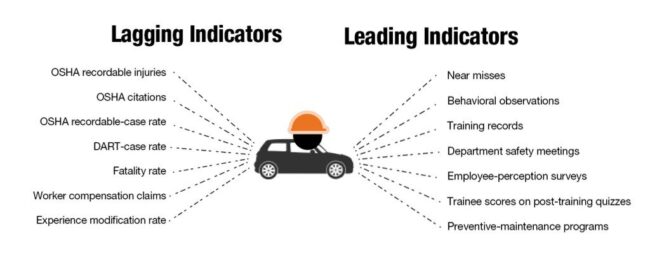
Safety Indicators – Leading vs Lagging – What’s the difference??
Humans love to measure everything. Some measurements, like how many gallons/cases of liquor we’re pumping out, are fantastic. There is a direct correlation with the amount of cases shipping out and business continuity.
Some measurements are not so great, such as traditional safety measures like injuries.
Injuries are a very important measurement. Health & Safety Protocols exist to ensure workers go home safely each day. However, it is also important to understand if work is being done safely. Can you determine if you are truly working safely? To find out, companies use two opposing metrics: Leading indicators and lagging indicators.
What’s the difference..?
In short,

Looking at the cases shipped analogy, the cases shipped are leading indicators. A low case count alert is a leading indicator. The activity of loading cases on a truck is a leading indicator. Running out of cases due to an empty finished goods warehouse is a lagging indicator. This is an overly simplistic example, but it is certainly effective in showing the delineation between prevention and reaction to an incident.
What are we doing at Heaven Hill??
In addition to tracking our OSHA required lagging indicators, our production locations actively have many leading indicators! Some include departmental safety committee meetings, safety trainings, implementation of an audit inspection program (Preventative Maint. Program), and more. One of our exciting FY23 announcements is transitioning our Safety KPI’s (Key Performance Indicators) from lagging indicators to leading Indicators.
If you have any questions about this work, reach out to Taylor Duncan ([email protected]).